

The course at a glance
| When | What happens |
|---|---|
| Day 1–10 | Slight redness and small scabs that come off with the daily wash. |
| Week 2–8 | The transplanted hair shafts fall out (“shedding”), the roots stay. |
| Month 3–4 | New, initially fine hair begins to grow. |
| Month 6 | Clearly visible density, the hair gets stronger. |
| Month 9–12 | The hair gets thicker and can be styled freely. |
| Month 12–18 | Final result, especially at the crown. |
The first ten days
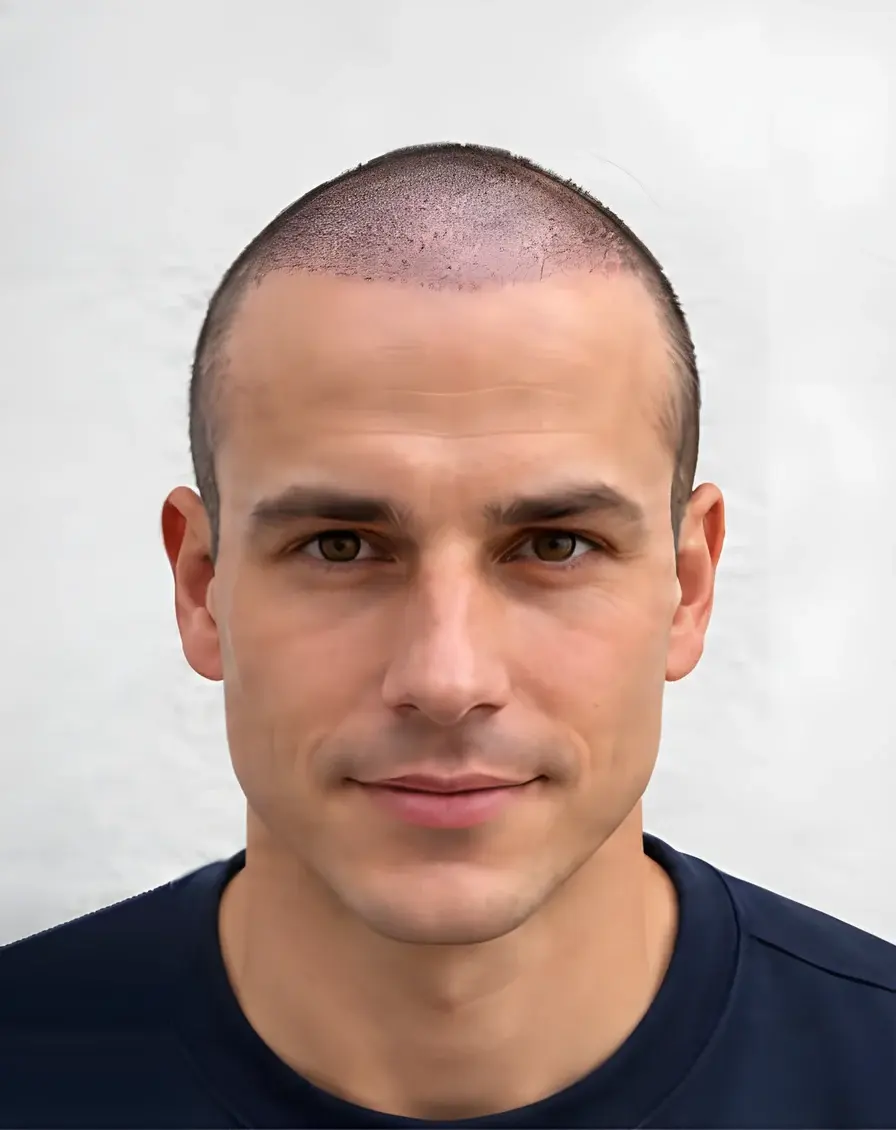
Right after the procedure the recipient and donor areas are slightly red. Small scabs form around the grafts and come off with the daily hair wash after about ten days. Slight swelling on the forehead may occur in the first days and goes down by itself.
Weeks 2 to 8: shedding
Now most of the transplanted hair falls out. This is not a failure but normal: the root stays in the skin and forms a new hair over the next months. In this phase many patients look roughly as they did before the procedure. Read more in the guide “Shedding after a hair transplant”.
Months 3 to 6: the new hair comes
From the third month the first new hair grows, at first fine and light. By the sixth month it gets stronger and the density becomes clearly visible. The hairline is then usually already easy to see.
Months 9 to 18: the final result
Between the ninth and twelfth month the hair gets thicker and can be styled freely. Growth often takes longer at the crown, so the final result there sometimes only shows after eighteen months.
What influences the result
- Quality and density of the donor area.
- Hair thickness, hair colour and contrast with the scalp.
- Careful aftercare in the first two weeks.
- No smoking and no alcohol during healing.
- How your own, non-transplanted hair develops.
Support over twelve months
With Mese Medical you send photos to your coordinator after one, three, six and twelve months, and our head surgeon reviews your progress. If you are unsure in between, simply message us on WhatsApp.